
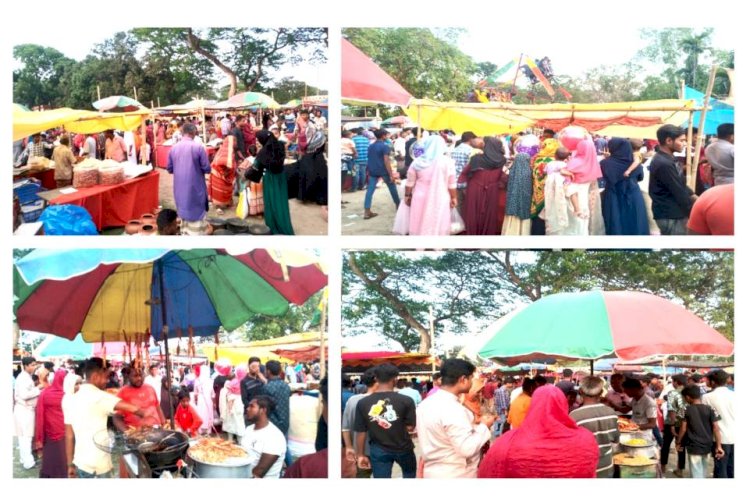
As in every year, the 240-year-old historic "Napai Chandi Mela" has been held in Pirgacha.
Daily Bijoy News Pirgacha (Rangpur) Correspondent:
The historic 240-year-old "Napai Chandi Mela" has begun in Pirgacha, Rangpur. This fair is not just about entertainment—it is a manifestation of love and reverence for a revolutionary woman. At its heart lies the legendary heroic woman "Devi Chaudhurani", known to the masses as Devimata (Divine Mother) and in folklore as Chandi Devi or Chandi Mata. To the British, however, she was the "Bandit Queen."
She was the first female warrior to take up arms against the British in Bengal's history. Countless plays, novels, and films have been inspired by her. For centuries, this fair has been held annually in her birthplace to honor her sacrifice.
From a Mughal-aligned landlord to a rebel leader, Devi Chaudhurani—whose real name was Jaydurga Devi—was a powerful zamindar of the Manthana Estate in Pirgacha, Rangpur. Despite her aristocratic status, she stood by the oppressed, distributing food and money, and fighting against injustice. Her subjects called her Devimata, while folklore remembers her as Chandi Devi or Chandi Ma—a symbol of courage, compassion, and resistance.
A History Scorched by Rebellion
She organized armed resistance against British colonial rule, establishing secret bases along the Alai Kumari River in Chandipur, Pirgacha, alongside revolutionaries like Fakir Majnu Shah, Bhawani Pathak, and Shiv Chandra Ray. Here, secret meetings, training, and weapon drills took place. Fakirs and ascetics looted British ships and distributed resources among the poor—all under her leadership. She played a key role in India’s early freedom struggle, leading the Fakir-Sannyasi and peasant revolts.
Martyrdom & the "Bandit Queen" Title
On a Thursday morning in 1783, she was martyred in a direct battle with British forces in present-day Chandipur. The British labeled her a "Bandit Queen", yet to the people of North Bengal, she was a goddess in human form—their protector.
Origin of the Fair’s Name
Legend says that after her death, grieving villagers cried, "Napai Chandi!"—meaning "We will never get our Chandi back!" In the Rangpur dialect, "Napai" signifies loss or emptiness, while "Chandi" was the name of her spirit. Thus, the Napai Chandi Mela was born—a 240-year-old tradition of remembrance.
The Fair Today
Held every year on a Thursday in Boishakh (April-May) at Chandipur Government Primary School grounds, the fair is a vibrant spectacle. This year (May 1), hundreds of stalls sold toys, household items, cosmetics, and traditional snacks like muri-murki, batasha, sweets, and jilapi. Children enjoyed rides like Ferris wheels, toy trains, and electric boats. Despite the festive atmosphere, the fair carries a deeper historical weight.
Neglected Historical Sites
Near the fairgrounds stands a three-domed ancient structure—some call it a mosque, others a temple. A large pond and other ruins, believed to be from the Mughal era, lie nearby. The Manthana Zamindar Bari, where Devi Chaudhurani once lived, now crumbles in neglect, with no preservation efforts.
Demand for Preservation
Local researcher and former principal of Itakumari Shiv Chandra Ray College, Nazrul Islam Hakkani, states:
"Devi Chaudhurani was India’s first armed female freedom fighter. Yet, no government has taken steps to preserve her legacy. Protecting her history and sites could foster national pride, education, and even heritage tourism. She must remain alive in the memory of future generations."
Our Responsibility to History
The Napai Chandi Mela is not just a local fair—it embodies North Bengal’s historical consciousness, love, and respect. Devi Chaudhurani lives on not just in textbooks, but in the dust, sounds, and memories of this fair. Preserving, presenting, and keeping her legacy alive is a duty for all of us.
Daily Bijoy News / Atikur Rahman