
The actual founder of the influential Hindu zamindari in Narail was Kalishankar Roy.
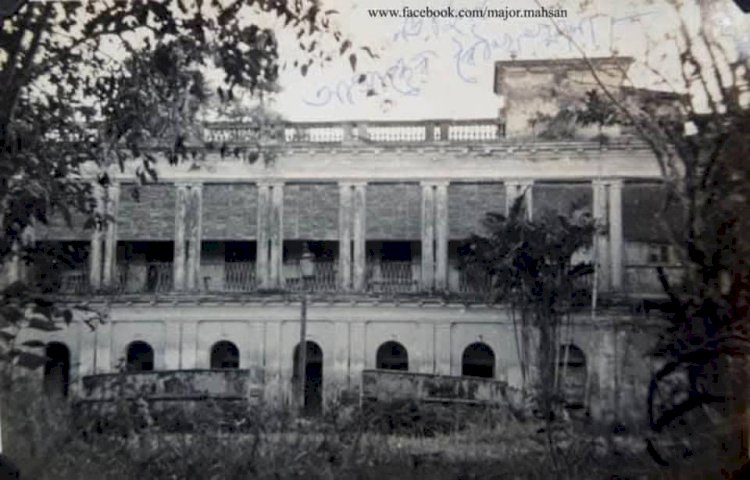
Daily Bijoy News, Narail District Correspondent:
The actual founder of the Narail Zamindari was an influential Hindu named Kalishankar Roy. His father's name was Ruparam Roy. Ruparam Dutt married the second daughter of Krishnaram Mitra, from the famous Guatli Mitra family. Ruparam Dutt was the father of three sons: Nandakishore, Kalishankar, and Ramnidhi. Ujjal Roy, District Correspondent from Narail, informs that Ruparam took a job in the Natore Raj office at a young age. Gradually gaining trust, he worked as the government's lawyer (Vakil) at the court of the Nawab of Murshidabad. In this way, he amassed considerable wealth. One day, Rani Bhabani, the Zamindar of Natore, sent Ruparam Roy to the Nawab's court in Murshidabad as their lawyer. Through the grace of Natore's Rani Bhabani, Ruparam Roy purchased the Aladatpur taluk in Narail. Within this taluk, at a place called Narail, he built a residence. Some distance away from the residence, on the banks of the Chitra River, Ruparam Roy built a market. Named after Ruparam, this market became known as Rupganj Bazaar. Even today, this market is famous as the city's main commercial center. References: 1) History of Jessore-Khulna - Satishchandra Mitra, 2) Bharat Gourab - Accounts of some Zamindar families of Bengal - Surendramohan Basu, 3) Bonedi Kolikatar Gharbari - Debashis Bandyopadhyay.
Among Ruparam Roy's three sons, Kalishankar Roy entered the Natore Raj court with his father at a very young age. Like his father, he was appointed as an employee of the Natore Raj government at a young age. This Kalishankar was the actual founder of the Narail Zamindari. Kalishankar Roy was possessed of robust health and was an astute individual. To achieve success himself, he had no consideration for right or wrong in his character. He was adept at accomplishing his tasks through cunning. His echo is heard in Westland's report: "Kalisankar was a man of wonderful energy and ability in business - my regard for truth compels me to say it - he was perfectly unscrupulous." In accomplishing his tasks, he did not distinguish between right and wrong.
When Lord Cornwallis, the Governor-General of India, introduced the Permanent Settlement in 1793, a huge amount of revenue fell into arrears for the vast Natore Zamindari. Due to revenue arrears, the zamindari began to be sold off in parts at auctions. At that time, the cunning Kalishankar and some other employees, misusing the trust of the Natore zamindars, began purchasing parganas (estates) belonging to the Natore Raj territory at auctions, in their own names and under pseudonyms. These parganas were Telihati, Binodanpur, Rupapat, Taraf Kalia, Taraf Dariyapur, and other small tomigati mahals. In the Narail mouza, Kalishankar Roy built large buildings, several ponds, a natya mandir (performance hall), and a massive palace at his father's smaller residence.
To increase his power, influence, and prestige, Kalishankar formed a large lathiyal (club-wielding) force. Most of the people joining this force were from the Hindu lower-caste Namashudra community. Wherever force was needed, this lathiyal force was employed. Often, the merchandise from traders' boats would be looted by this lathiyal force.
During the time of Mr. Henckell, the first Judge-Magistrate of Jessore (1784 AD), a case of looting was filed against Kalishankar and his elder brother Nandakishore. Possibly, Kalishankar, angered over a business debt, looted a boat full of goods. Mr. Henckell labeled him a 'dacoit' and reported him to the government. Some sepoys under Kutubullah Sardar were sent to arrest Kalishankar. A skirmish ensued with his 1500 lathiyals. In the fight, 2 were killed and 15, including Kutubullah, were injured. When the Sahib sent additional troops a second time, Nandakumar was captured, but Kalishankar fled. He first hid in Natore and then in Calcutta. After a long time, he was arrested from Calcutta with great difficulty and then brought to Murl. He was acquitted in the Daroga's trial.
If Kalishankar learned of any incident of cow slaughter in his zamindari area, he would immediately have his lathiyals arrest the person and subject them to cruel torture. No one could walk on the road in front of his house with an umbrella over their head or shoes on their feet. This Kalishankar is the true founding figure of the Narail Zamindari.
In 1810 AD, at 70 years of age, Kalishankar went to Gaya-Kashi to prepare for his final religious journey and death. In Kashi, pilgrims were constantly troubled by the harassment of miscreants. He could not bear this sight. Through various clever strategies, he got the oppressors sentenced by the royal court and made Kashi free from disturbance. The residents of Kashi still remember the name of Kalishankar Roy for restoring Kashi to a peaceful state. Kalishankar passed away in the holy Kashi Dham in 1834 at the age of 85.
Kalishankar had two sons: Ramnarayan and Jay Narayan. Before going to Gaya-Kashi, he handed over all his property to his two sons. A few years after Kalishankar went to Kashi, both sons died. Ramnarayan died in 1817 and Jaynarayan in 1822. Kalishankar's elder son Ramnarayan had three sons: Ramratan, Harnath, and Radhacharan. The younger son Jaynarayan had two sons: Durgadas Roy and Gurudas Roy. All three sons of Ramnarayan were accomplished men.
Durgadas Roy and Gurudas Roy settled in a village called Hatbariya, two miles south of Narail on the banks of the Chitra River, and began managing the zamindari equally. Ramnarayan's descendants continued to live in Narail. Therefore, the zamindars of Narail and the descendants of Jaynarayan became known as the 'Zamindars of Hatbariya'.
The post office in Narail town's Rupganj Bazaar was established in the name of Ramnarayan's eldest son, Ramratan. From that era, it has been known as the 'Ratangunj' post office. Even today, the name of this post office has not changed. During Ramratan Roy's zamindari, the Naldi pargana and the Dantiya pargana of Khulna district were included. At this time, English indigo planter Sahibs established indigo factories in the Jessore and Kushtia regions for indigo cultivation. Zamindar Ramratan Roy, believing indigo cultivation to be profitable, also started this business. He established many indigo factories and also purchased some factories from English indigo planters. Ramratan was very communal-minded. His lathiyal force would brutally oppress those farmers who were reluctant to cultivate indigo. Comparatively more oppression was inflicted upon Muslim farmers than on the Hindu Namashudra community. Although Zamindar Ramratan Roy was communal-minded and oppressive, he was charitable in the field of education. Zamindar Ramratan Roy established an English high school in the name of the then Empress of India, Maharani Victoria, which now bears his memory as the Narail Government Victoria Collegiate High School. Centering this school, an Intermediate College was established in 1886 under the same name. This college is the second oldest under the University of Rajshahi and one of the oldest colleges in the Khulna and Barisal divisions.
Ratan Babu had established a charitable hospital. Ratan Babu's son, Kaliprasanna, was very devout and religious. Ray Bahadur Harnath Babu's grandson, Kiran Chandra, was honored with the title 'Ray Bahadur' by the Governor. His nephew, Bhavendrachandra, was highly educated and a philanthropist. Radhacharan Babu's son, Jogendranath Roy, was an educated and intelligent zamindar. His eldest son, Jatindranath Roy, passed the Indian Civil Service examination from England with great distinction and served as a Magistrate for many years.
After the death of Zamindar Ramratan Roy, his middle brother, Ray Bahadur Harnath, took over the authority of the zamindari. He was the first to spend a lot of money for the construction of the paved road that we use today, extending from present-day Narail to Jessore.
In 1786, Jessore was recognized as a district. The then Jessore district comprised the entire present-day Jessore, Khulna, India's Bangaon district, and parts of Kushtia and Faridpur. In 1793, the eastern part of Faridpur district, including the Naldi pargana, such as Kashiani, Mokshedpur, Kotalipara, Boalmari, Gopalganj, were then part of Jessore district. In 1842, Khulna was made a subdivision of Jessore. At that time, Abhaynagar Thana and Kalia Thana were part of Khulna subdivision. In 1861, during the Indigo Rebellion, Narail subdivision was established. Due to the influence of the Narail zamindars, the subdivision was named Narail, and the subdivision headquarters was established in Narail. For establishing the subdivision headquarters, locations were initially selected at Gopalganj, then Bhatiapara, Kalna, Lohagara, Naldi, and finally in the Mahishkhola mouza of the present district town.
The Narail Zamindar's house covered a vast area with many elegant buildings, a performance hall, puja pavilions, a kachari (office) building, a guest house, rest houses used as temporary residences for famous baijis (courtesans), and numerous ponds and tanks. Historical research indicates that no other zamindar in the then East Bengal had such a large house. After the creation of Pakistan in 1947 based on the two-nation theory, the zamindars left this country and moved to Calcutta, India. Around 1950 and 1952, a few of the zamindars came from Calcutta for a short while but did not return later. From after the creation of Pakistan, for a long time, due to lack of maintenance, the old buildings fell into disrepair, and various materials were stolen or destroyed. After the independence of 1971, a camp for the Rakhi Bahini, formed by the then Awami League government, was set up here. Furthermore, the mansion buildings were used for a long time as residences for government revenue department employees. Around 1985, the government sold the huge mansion of the zamindar's house at auction for only five lakh taka. Except for a temple in front of the zamindar's house, no other memories remain. A government Shishu Sadan (children's home) has been established here. Additionally, the District Police Lines have been established on about 10 acres of land belonging to the zamindar's house. The ponds and tanks of the zamindar's house still stand as witnesses to history. Various communities who worked for the zamindars - such as Behara (palanquin bearers), Rajmistry (masons), Lathiyal or Dhali (guards), priests for worship, and the Das community for various service works - lived in the villages to the south and west of the zamindar's house. The descendants of these communities have changed their professions, and many have now taken up other occupations through education. With the change of time, the symbols of the zamindars' wealth and affluence - the vast zamindari and beautiful palace buildings - have vanished. But the people of Narail have not forgotten the memories of the zamindars' oppression.
Daily Bijoy News / Ujjal Roy