Encampment negotiations continue as U of T threatens eviction Monday morning

Daily Bijoy News Special Correspondent:
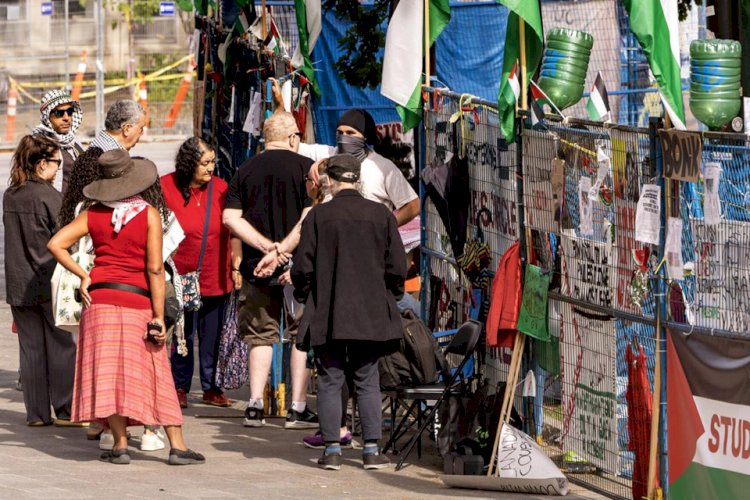
Tensions remained high as the sun set on the University of Toronto’s student encampment Sunday, with negotiations continuing between university administrators and pro-Palestinian student protesters ahead of anticipated eviction efforts Monday morning. At 8 a.m., the deadline for them to leave, protesters and their supporters are hosting a rally they hope will insulate them from any potential police efforts to dismantle the encampment. They also plan to send lawyers Monday morning to fight the urgent injunction U of T is seeking against them to end the weeks-long standoff. Neither side publicly shared an update on talks late Sunday night. Minutes before the meeting, university officials warned that regardless of the outcome of the talks, protesters must tear down the encampment Monday or face legal action.
The encampment was set up at the heart of the university’s downtown campus on May 2 as part of a massive wave of pro-Palestinian demonstrations at post-secondary institutions in Canada and the United States. U of T protest organizers have called on the university to cut its ties with Israel, divest from companies profiting from Israel’s offensive in Gaza, and terminate partnerships with the country’s academic institutions that they deem complicit in the war. For supporters, the protest has been a peaceful show of solidarity amid the war in Gaza. Critics, meanwhile, have characterized it as an intimidating presence on campus that has included shows of antisemitism.The university sent a notice of trespass to the protesters Friday afternoon, requiring them to tear down the encampment at King’s College Circle and warning that any students involved could be suspended, and any participating faculty and staff fired if they do not comply. Jeff Bale, faculty association vice-president of the university and external affairs, said faculty learned of this threat to their jobs through media reports and are currently seeking legal advice.
He said he was shocked by the step, adding that mass termination was never mentioned as a possibility in the multiple meetings faculty had held with administrators and the faculty association’s memorandum of understanding with the university grants them the protection to criticize the university. “This really is, to our best knowledge, the first time the university has made a public threat of mass termination,” said Bale. “The severity and the uniqueness of that move really, really shocks people and makes them concerned.” Deb Cowen, a professor in U of T’s department of geography and planning, called the threat “outrageous,” counter to “the fundamental purpose of the university” and a challenge to their “rights as citizens of a democracy.” Cowen said the university is contravening its values by trying to shut down a protest against itself. “I’ve talked to many faculty members who are not committed to the substance of the issue but are now coming to the encampment because they are so outraged by the administration’s arrogance.
Yet for other faculty, the encampment is a blight the university administration has allowed for too long. Robert Schwartz, a professor at U of T’s School of Public Health, said the encampment’s anti-Israel stance is hateful and he looks forward to the day it is no longer there.
“The university is not doing anything to negate the freedom of speech the faculty members and students have, they’re free to protest in different ways, but it’s not reasonable for them to take the centre of the university hostage,” he said. “What else is the university to do? It’s made it very clear this encampment is against its policies. It has to enforce them in some way.”
Ahead of Sunday’s negotiations, the protesters said they planned to present a counter-offer to school adminstrators. Among its elements was a plan for the university to disclose any public investments linked to Israel’s military campaign in Gaza and to create a joint working group to study its private investments. Protesters also want U of T to cut ties with two Israeli academic institutions, which they say have a presence in illegal settlements and aid in the development of Israeli military technology.
University president Meric Gertler told a news conference on Thursday the encampment “must end,” saying the protest has put “tremendous stress on our entire community.” He said convocation, which begins June 3, will go ahead as scheduled, and that the university aims to have the encampment cleared by then — and did not rule out asking police to dismantle the encampment. Gertler had outlined an offer to the protesters Thursday that marked a shift in approach and seemingly in tone by the school, saying that if protesters left, U of T would create committees to consider divesting from Israel over the next several months. However, he said the school will not cut ties with any Israeli academic institutions. Encampment spokesperson Erin Mackey said Friday that protesters want “upfront commitments” on divestments and disclosure from the university, not “vague committees” to study the matter. “It’s disheartening that despite agreeing to this meeting, the university is still going forward with this trespass notice,” said Mackey. “We are here, we’ll continue to be here until we get divestment.” If protesters stay after getting the notice of trespass, they could be fined up to $10,000, but would have an opportunity to defend themselves in court.
Refusing to leave after being ticketed could lead to arrests, but the university cannot compel police to arrest the protesters, as that is up to the discretion of police. At the University of Alberta, a similar encampment was forcefully dismantled by police using tear gas and batons earlier this month, while U.S. student encampments have led to hundreds of arrests. Some pro-Palestinian demonstrators have reached agreements with their universities: protesters at McMaster University voted Friday to end their encampment, after the university agreed to comply with key demands around collaboration and financial transparency.
A University of Toronto spokesperson confirmed in a statement Sunday it would be seeking an injunction through an urgent hearing if students did not comply with the trespass notice. The Ontario Federation of Labour, which represents 54 unions across the province, came out in support of the encampment’s right to protest on Saturday and expressed disappointment in the university’s trespass notice In a statement, OFL president Laura Walton urged U of T to “reverse course immediately,” and called on trade union members to join a solidarity rally at the encampment on Monday at 8 a.m. “If, by then, you decide to move against the students, you’ll have to go through the workers first,” wrote Walton. The Oct. 7 attack by Hamas against Israel killed about 1,200 people and saw about 200 taken hostage. Since then, the Israeli military campaign in Gaza has killed more than 35,000 Palestinians, according to health officials in the territory and precipitated a humanitarian crisis.
Daily Bijoy News/ E